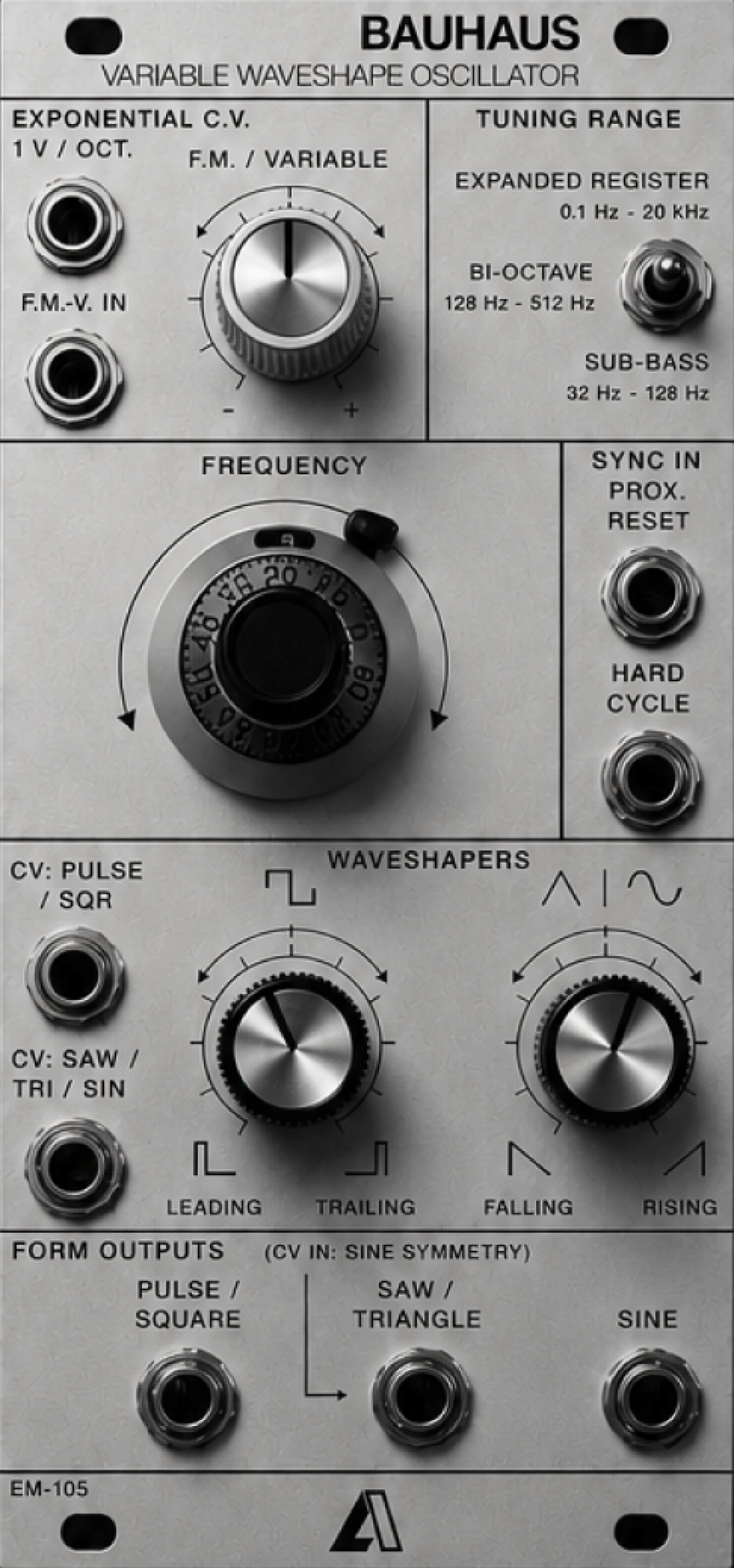
Rather than generating static waveforms, the architecture relies on parallel discrete waveshaping networks for continuous timbral modulation. This topology divides modulation into twin distinct zones: an analog symmetry circuit that interpolates smoothly between falling ramp, true triangle, and rising sawtooth geometries, balanced by an independent high-slew-rate comparator threshold network for precise pulse-width variations. Concurrently, a dedicated piecewise-linear diode matrix suppresses higher-order harmonics to isolate an exceptionally pure, low-distortion sinusoidal profile.
At the center of the instrument is a highly accurate multi-turn manual frequency control employing high-reduction mechanical coupling for exceptionally fine adjustment throughout the oscillator's operating range. An integrated mechanical lock allows the selected frequency to be physically secured once established, preventing accidental displacement during performance or calibration. The result is a deliberately tactile relationship between manual control and oscillator stability: coarse frequency movement remains immediate, while precise pitch placement can be established and retained mechanically.
Temporal behavior is governed by a dual-topology synchronization system that moves away from conventional, deterministic state-resetting. A dedidicated high-impedance JFET proximity circuit provides soft-locking phase alignment for fluid sub-harmonic generation—resulting in an instrument that serves equally as a stable low-frequency timing anchor or a highly articulated audio-rate modulation source. The hard cycle sync injects external pulses directly into the comparator's active feedback loop, disrupting its internal memory to produce a phase- and slope-dependent harmonic grain.
At modest relationships between respective synchronized frequencies, this produces animated harmonic locking substantially different from an ordinary fixed-state reset. Under wider pitch excursions, the interaction becomes increasingly severe: the core is repeatedly forced through abrupt, phase-dependent changes in its charging cycle, generating irregular harmonic discontinuities, pronounced intermodulation, and an aggressive acoustic grain. Rather than producing the mechanically uniform sweep associated with conventional hard synchronization, dynamic frequency movement can fracture into jagged spectral transitions and intensely articulated harmonic structures.
Taken together, the EM-105 can function as a stable precision pitch source, an extremely slow control oscillator, or a highly animated audio-rate modulation instrument. Its architecture deliberately separates frequency establishment, calibrated pitch control, exponential modulation, continuous waveform geometry, and two distinct forms of synchronization, allowing each element of the oscillator's behavior to be addressed independently while remaining anchored to the same precision core.
BAUHAUS
MODEL : EM-105
VARIABLE WAVESHAPE OSCILLATOR
A continuously variable oscillator architecture designed to traverse transitions between canonical waveform states.
The EM-105 is an oscillator engineered around a thermally compensated, discrete sawtooth integrator core. Utilizing matched transistor arrays instead of standard integrated operational amplifiers, the instrument delivers robust exponential 1 volt per octave tracking across an eight-octave register. Its operational bandwidth spans three discrete, switchable frequency bands, bridging the space between sub-audible 0.01 Hz control cycles and the 20 kHZ audio spectrum.
ALL RIGHTS RESERVED.
MMXXVI
|
©
L.A.
CIRCUITS
CORPORATION
SONIC
DESIGN
&
ARCHITECTURE
INSTRUMENTS
A continuously variable oscillator architecture designed to traverse transitions between canonical waveform states.
The EM-105 is an oscillator engineered around a thermally compensated, discrete sawtooth integrator core. Utilizing matched transistor arrays instead of standard integrated operational amplifiers, the instrument delivers robust exponential 1 volt per octave tracking across an eight-octave register. Its operational bandwidth spans three discrete, switchable frequency bands, bridging the space between sub-audible 0.01 Hz control cycles and the 20 kHZ audio spectrum.
Rather than generating static waveforms, the architecture relies on parallel discrete waveshaping networks for continuous timbral modulation. This topology divides modulation into twin distinct zones: an analog symmetry circuit that interpolates smoothly between falling ramp, true triangle, and rising sawtooth geometries, balanced by an independent high-slew-rate comparator threshold network for precise pulse-width variations. Concurrently, a dedicated piecewise-linear diode matrix suppresses higher-order harmonics to isolate an exceptionally pure, low-distortion sinusoidal profile.
At the center of the instrument is a highly accurate multi-turn manual frequency control employing high-reduction mechanical coupling for exceptionally fine adjustment throughout the oscillator's operating range. An integrated mechanical lock allows the selected frequency to be physically secured once established, preventing accidental displacement during performance or calibration. The result is a deliberately tactile relationship between manual control and oscillator stability: coarse frequency movement remains immediate, while precise pitch placement can be established and retained mechanically.
Temporal behavior is governed by a dual-topology synchronization system that moves away from conventional, deterministic state-resetting. A dedidicated high-impedance JFET proximity circuit provides soft-locking phase alignment for fluid sub-harmonic generation—resulting in an instrument that serves equally as a stable low-frequency timing anchor or a highly articulated audio-rate modulation source. The hard cycle sync injects external pulses directly into the comparator's active feedback loop, disrupting its internal memory to produce a phase- and slope-dependent harmonic grain.
ALL RIGHTS RESERVED.
MMXXVI
|
©
CIRCUITS
L.A.
CORPORATION
At modest relationships between respective synchronized frequencies, this produces animated harmonic locking substantially different from an ordinary fixed-state reset. Under wider pitch excursions, the interaction becomes increasingly severe: the core is repeatedly forced through abrupt, phase-dependent changes in its charging cycle, generating irregular harmonic discontinuities, pronounced intermodulation, and an aggressive acoustic grain. Rather than producing the mechanically uniform sweep associated with conventional hard synchronization, dynamic frequency movement can fracture into jagged spectral transitions and intensely articulated harmonic structures.
Taken together, the EM-105 can function as a stable precision pitch source, an extremely slow control oscillator, or a highly animated audio-rate modulation instrument. Its architecture deliberately separates frequency establishment, calibrated pitch control, exponential modulation, continuous waveform geometry, and two distinct forms of synchronization, allowing each element of the oscillator's behavior to be addressed independently while remaining anchored to the same precision core.
1
0
0
0
0
0
EM-105
MODULATION
SOURCE PROCESSOR
BAUHAUS