ST. TROPEZ
DUAL BLACKMER
VOLTAGE-CONTROLLED AMPLIFIERS
The EM-301 is a dual-channel voltage-controlled amplifier built around the THAT2181A, a monolithic current-mode VCA fabricated using a complementary dielectric-isolation process. The device's matched NPN/PNP architecture yields the low control-voltage feedthrough, wide dynamic range, and low static distortion required of audio-frequency gain-control applications — properties historically associated with discrete Blackmer-topology designs, here realized in integrated form.
Each of the two identical channels provides independent bias and modulation-depth control
together with a continuously variable control-law response—exponential, linear, or logarithmic, selectable across a single rotary control rather than switched between discrete positions. Channel outputs may be used independently or summed passively at the second channel's output jack, permitting series or parallel gain-staging without external patching.
The design privileges a single principle throughout: the control voltage should shape gain exactly as specified, and the audio path should add nothing beyond that specification.
MODEL : EM-301
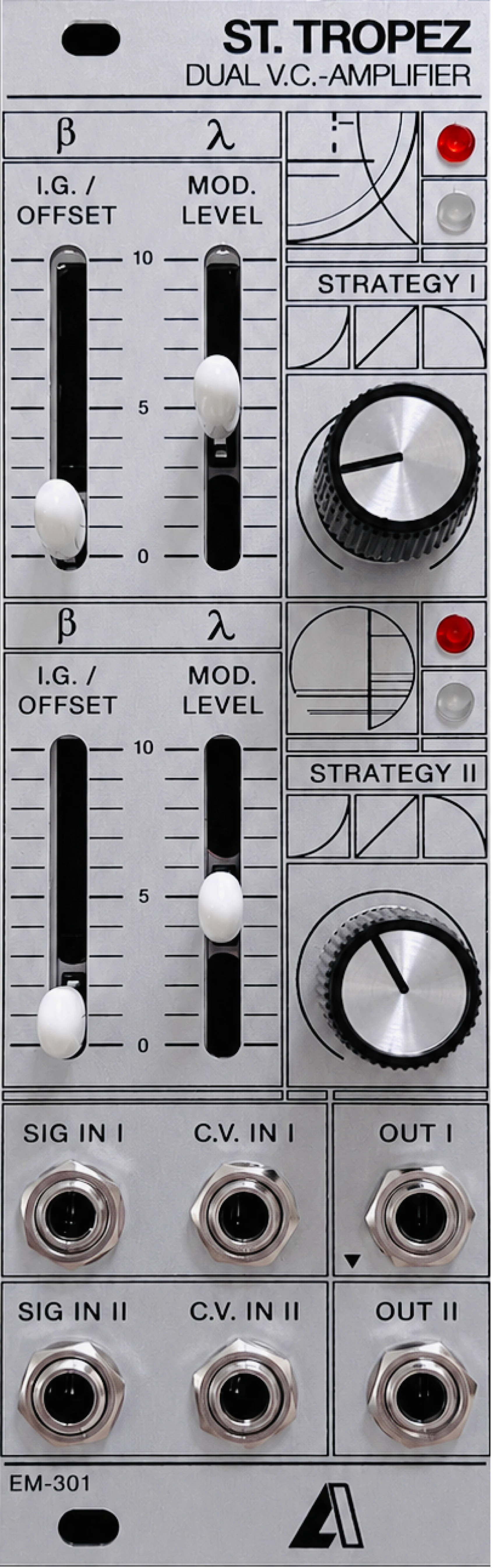
Each of the two identical channels provides independent bias and modulation-depth control, together with a continuously variable control-law response — exponential, linear, or logarithmic, selectable across a single rotary control rather than switched between discrete positions. Channel outputs may be used independently or summed passively at the second channel's output jack, permitting series or parallel gain-staging without external patching.
The design manifests a single principle throughout: the control voltage should shape gain exactly as specified, and the audio path should add nothing beyond that specification.
OVERVIEW
ALL RIGHTS RESERVED.
MMXXVI
|
©
L.A.
CIRCUITS
CORPORATION
SONIC
DESIGN
&
ARCHITECTURE
INSTRUMENTS
Each of the two identical channels provides independent bias and modulation-depth control, together with a continuously variable control-law response — exponential, linear, or logarithmic, selectable across a single rotary control rather than switched between discrete positions. Channel outputs may be used independently or summed passively at the second channel's output jack, permitting series or parallel gain-staging without external patching.
The design privileges a single principle throughout: the control voltage should shape gain exactly as specified, and the audio path should add nothing beyond that specification.
The design manifests a single principle throughout: the control voltage should shape gain exactly as specified, and the audio path should add nothing beyond that specification.
ALL RIGHTS RESERVED.
MMXXVI
|
©
CIRCUITS
L.A.
CORPORATION
The EM-301 is a dual-channel voltage-controlled amplifier built around the THAT2181A, a monolithic current-mode VCA fabricated using a complementary dielectric-isolation process. The device's matched NPN/PNP architecture yields the low control-voltage feedthrough, wide dynamic range, and low static distortion required of audio-frequency gain-control applications — properties historically associated with discrete Blackmer-topology designs, here realized in integrated form.
Each of the two identical channels provides independent bias and modulation-depth control together with a continuously variable control-law response—exponential, linear, or logarithmic, selectable across a single rotary control rather than switched between discrete positions. Channel outputs may be used independently or summed passively at the second channel's output jack, permitting series or parallel gain-staging without external patching.
ST. TROPEZ
1
0
0
0
0